Open Science practices
Throughout my research, I follow Open Science practices to make my work as open, transparent, and reproducible as possible. For example, I frequently preregister my studies and share the data, analysis code, and experimental tasks so that others can see how the work was done and reproduce my findings.
Most of my published studies have a corresponding project on the Open Science Framework (OSF). However, since the recent changes to OSF, I have started using ResearchBox instead.
Explore my OSF projects ↗An example project
Familiar sequences are processed faster than unfamiliar sequences, even when they do not match the count-list
For example, in 2024 we published a study exploring the role of familiarity in number order processing. Specifically, we explored why some number sequences are easier to judge as “in order” than others, and whether this reflects their consecutiveness or familiarity. We asked people to judge the familiarity of 30 number sequences before judging their order. We found that more familiar sequences were processed faster than less familiar sequences, irrespective of their consecutiveness.
Alongside the article, we shared both tasks used in the experiment, as well as all the data and analysis scripts. This means that anyone can freely download and reuse these materials in their own research.
Explore the OSF project ↗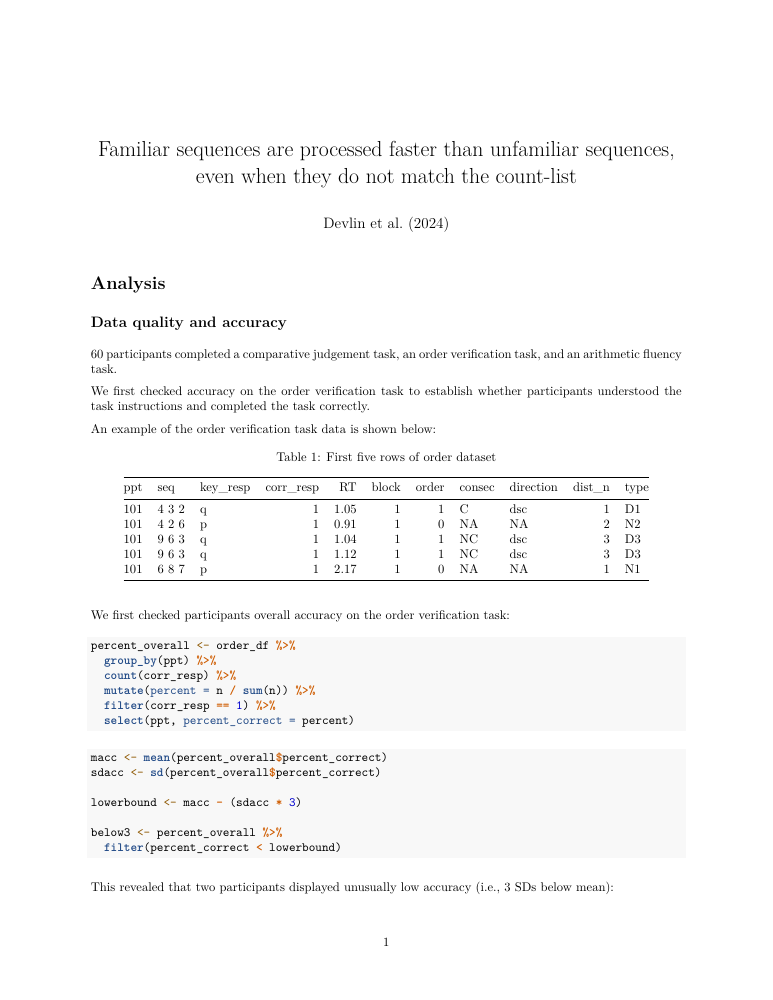
Experimental tasks
The PsychoPy tasks we used are all on OSF, along with their supporting files. You’re welcome to download them and use or adapt them for your own studies.
Explore the tasks ↗Data and analysis
The data and analysis code are there too. You can use them to reproduce our results, try a different analysis, or check for mistakes!
Download data ↓Download analysis source ↓Readable analysis report
If you don’t use R, you can still follow what we did. The PDF below brings together the code, results, and explanations of each step of the analysis.
Open report ↗Download PDF ↓Preview the analysis report
Sequence familiarity scores
One of the main outcomes was a set of familiarity scores for 30 number sequences. If you’d like to apply this measure to your own data, or use it to choose sequences for a study, you can download the scores here.
Download familiarity scores (CSV) ↓Opens in Excel
| Sequence | Familiarity score |
|---|---|
| 1 2 3 | 100.00 |
| 3 2 1 | 85.32 |
| 2 3 4 | 78.00 |
| 3 4 5 | 65.06 |
| 4 5 6 | 63.00 |